When Melissa (name changed) first came to see me about her right knee, she could do most everyday things fine.
She could walk her dog. Tend to her backyard orchard. Drive her kids around. Move around the house.
But she didn't trust her knee.
A sideways step could make something feel like it had shifted out of place.
Sometimes the knee would catch. Deep bending was difficult.
Swimming or jumping could leave the knee feeling vulnerable afterward.
That uncertainty was perhaps more frustrating than the pain itself.
Melissa was an active 46-year-old who enjoyed Pilates and exercise.
She wanted to sweat, swim, jump around during a workout.
Take a ski trip with her family.
She wanted to be able to “be adventurous” with her body and trust that it could handle it.
She was worried about the opposite: losing mobility and doing more damage to the knee.
Why did her knee still feel vulnerable after surgery and rehab?
Melissa had a history of knock knees and eventually tore her meniscus badly enough that she couldn't fully extend her leg. She had to have surgery to repair the meniscus. After surgery, she did extensive physical therapy to rebuild strength in her legs.
Then she went to Hawaii and decided to go for a swim. The swimming didn't hurt initially, but afterward the knee began bothering her again.
She found herself in a frustrating cycle: Do more → irritate the knee → back off → feel better → try something again → irritate it again.
She had also tried bodywork, acupuncture, infrared treatments and a PRP procedure to speed up tissue healing after one of the flare ups.
This wasn't a case of someone who simply hadn't strengthened her knee enough or hadn't sought appropriate medical care.
As a long time Pilates instructor, she had good body awareness but was feeling that there was a gap: she didn't know how to get “it all to come together.”
She wanted to understand what she was doing in movement that might be making the knee work harder than it needed to.
That is where our work began.
The 3 milestones that took her knee from ‘clunky’ to ‘bouncy’
After examining where in her knee, Melissa was experiencing the strain, I asked the question:
What was the rest of her body doing when she used her knee?
This question led us through a journey with three important milestones.
Treating the knee and its relationship to the rest of the body
A knee doesn't walk by itself.
Your foot meets the ground. Your ankle adapts. Your pelvis shifts over your leg. Your spine responds. Your chest and shoulders participate.
All of those relationships determine how force travels through the knee.
This is one of the pillars of my framework: RELATIONSHIPS
Instead of treating the painful part as an isolated problem, I look at the relationships between different parts of the body and ask: Where might something else be making this movement harder than it needs to be?
For Melissa, we went looking for those relationships in one of the most ordinary things she did every day.
Walking.
That brings us to another important pillar of my work: examining relationships in EVERYDAY ACTIVITY.
2. The ‘wild’ discovery from examining one everyday activity
Melissa didn't think walking was the problem. In her mind it was the more demanding movements like jumping and swimming, that made her knee feel vulnerable.
But the way we organize ourselves doesn't suddenly appear when we jump, ski or exercise. Many of the same relationships between our feet, legs, pelvis and upper body are already present in something as ordinary as walking.
That's why everyday movement gives us a useful place to look. We can slow it down enough to notice patterns that become much harder to see once the movement gets faster or more demanding.
When we slowed down walking enough, I could see a pattern that repeated itself at each step. That led to a discovery neither of us would have found by looking only at her knee.
Melissa had spent years holding her chest in a particular idea of “good posture.” She hadn't realized how much effort she was using to keep herself there. We began experimenting with what happened when she softened her chest instead.
The effect surprised her. When she softened her chest, she could immediately feel less pressure in her knee.
She continued experimenting with it during the week and repeatedly noticed the same connection.
It was ‘wild’ for her to feel relief in her knee just from softening the chest.
At first glance, the chest and a torn lateral meniscus don't seem to have much to do with each other. And that's part of the problem.
Our healthcare system has trained us to chase pain where it shows up.
We MRI the knee. We treat the tissues in the knee. We stretch and strengthen the muscles around the knee.
But it can leave us with a blind spot: the rest of the person attached to the knee.
3. The magic of replacing ‘correction’ with ‘curiosity’
This brings me to the most important pillar. We weren't trying to fix Melissa's chest. And we weren't giving her another posture rule to follow. We were helping her brain discover how the way she organized her chest during an everyday movement like walking could change what she experienced all the way down at her knee.
Sensory Movement is how we put these three ideas into practice.
We use subtle, playful movements and listening touch to explore Relationships in Everyday Movement with Curiosity instead of Correction.
Rather than telling Melissa how she should move, we gave her nervous system opportunities to experience different possibilities and notice which ones made movement easier.
In her case, one surprisingly small change in how she organized her chest changed what she felt all the way down at her knee.
The input was subtle. The change wasn't.
She began trusting herself, not just her knee
Over time, Melissa noticed moments when she wasn't thinking about the knee at all.
The stiffness began improving.
The catching became occasional and rare thing rather than something she was constantly dealing with.
One evening she wore heels to her husband's work party and her knee did fine!
My favorite part of her journey is when she began recognizing her own patterns, knew the shift she had to make and found relief.
She now knew how to investigate and help herself.
She began ‘playing’ with making subtle shifts while out and about as well as in her practice of Sensory Movement.
She could also use some of these explorations to ease the chronic SI and back tension she had experienced on and off for years.
In her words:“If the pain is not being done to me… there are ways I can approach it myself.”
That is a very different relationship with pain.
She began to trust her knees again.
What Melissa's story teaches us about persistent knee pain after meniscus surgery
If you've torn a meniscus or have arthritis, it can be easy to assume that every sensation you feel is simply the damaged tissue talking.
But structure and movement are not the same thing.
You can strengthen a leg without necessarily changing how you land on it.
You can become very good at consciously correcting your alignment without giving your nervous system another way to organize the movement.
And that on its own can be stress-inducing.
Our work helped her “embody good body mechanics enough” that she could return to the activities she loved safely and with more confidence.
Learning to sense what she was already doing, make subtle changes in the organization of the whole body, and give her nervous system more choices.
Not trying harder to hold her body correctly.
Subtle is Strong.
Sometimes the thing that changes your experience of your knee isn't another knee exercise.
Sometimes it's discovering that your knee was never moving alone.
Tired of doing the right things but still can’t trust your knee?
Maybe you've done Physical Therapy wondering what to do when physical therapy isn’t working for your knee?
Maybe you've strengthened your legs, stretched, rested, had injections or even had surgery?
And maybe you're able to do most things but you still hesitate before taking a hike, the ski trip, the workout or the long day of walking because you don't know how your knee will respond.
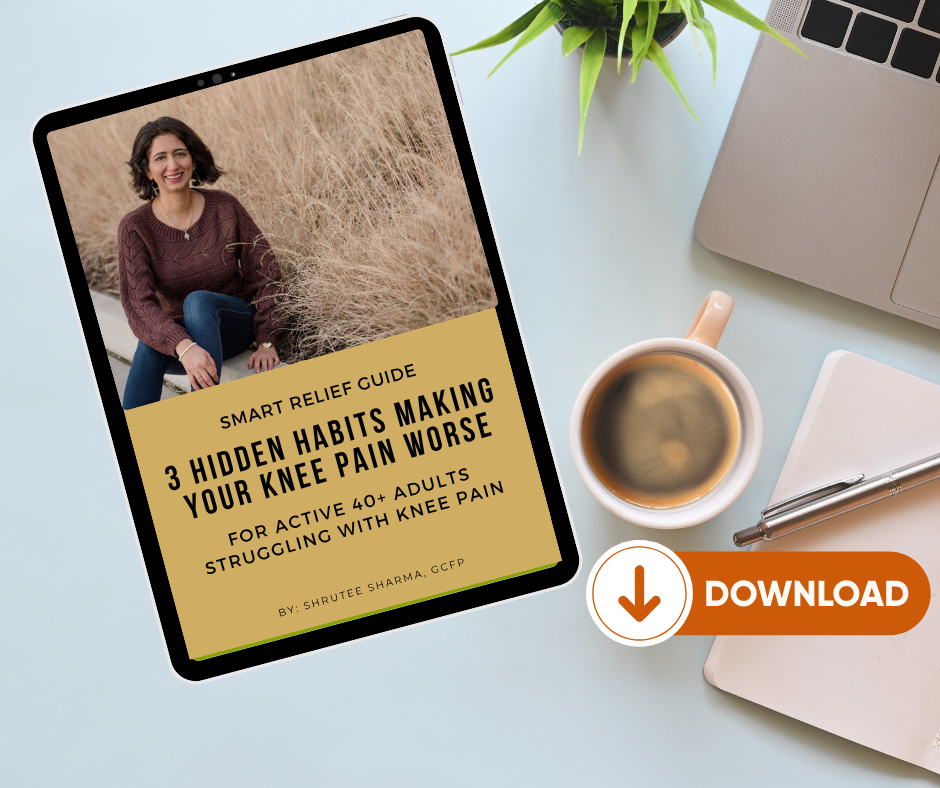
Download this free resource to discover 3 surprisingly common but hidden habits making your knee pain worse.
In this resource, I cover:
why your knee pain may not actually be a knee problem
how certain “good” habits can keep you stuck in the same pattern
simple ways to begin shifting how your body organizes movement without forcing or overcorrecting
Click here to download the guide.2.
Frequently Asked Questions
How is working with a movement practitioner different from getting more bodywork or medical treatments?
Medical procedures (like PRP, injections, or surgery) and bodywork (like massage or acupuncture) treat tissue structure or provide temporary relief from local symptoms. Movement re-education works directly with the nervous system to help you learn to move in ways that take away the strain on the tissues and muscles.
Another difference is about cultivating self-reliance. Instead of relying on a practitioner to fix you during weekly appointments, movement re-education gives you practical, self-directed awareness tools. You learn to recognize early warning signs in your own body and adjust them yourself before they turn into full flare-ups.
How long does it take to start feeling a change in my knee through this approach?
Many people experience immediate shifts in sensation like instant lightness or decreased joint pressure during their very first session when they learn to alter a whole-body movement habit (such as softening the chest or shifting pelvic weight). However, building lasting trust and long-term movement confidence typically takes a few weeks of consistent, gentle exploration and practice to allow your nervous system to integrate these new choices.
Sensory Movement is a body movement practice for anyone who wants to age with grace, vitality, and confidence, even after your injury or pain has healed. It will enable you to keep doing the things you love without tip-toeing around pain or fearing injury.