Why your knee hurts more going downstairs?
Knee pain feels worse going down stairs than knee pain going up stairs?
Whether its a sharp nervy sensation, a feeling of instability, or a protective bracing in the joint; it isn’t necessarily a sign of structural failure.
You might be surprised but it’s likely a lack of coordination bringing on your symptom.
Going downstairs reveals exactly how well (or how poorly) your entire body is working together.
The biomechanics of knee pain going downstairs
When you go down a step, you are moving forward AND lowering yourself with gravity. It is less like a step and more like a controlled fall. For this to feel effortless, your body has to gradually release weight on the front leg. When that control is missing, your body "collapses" into the movement, and the knee joint takes the hit of the impact. In those moments, it’s easy to blame your knee pain on bad genes or just getting older. But often, the real solution can be found in better, more coordinated movement.
Let me share a quick story that brings this idea to life.
Why strong legs aren’t enough to stop knee pain coming down stairs
Living here in the Pacific Northwest, I often work with mountain climbers. One client, a busy tech professional at Google and a doting dad of two girls used to climb mountains as his “me time.”
He had climbed Mt. Elbrus and was conditioning to climb Mr Rainier the year we met. He trained on tough local trails, went to the gym regularly, and even had a rowing routine. So this was someone with strong legs. And yet, coming down the mountain strained his knees and caused them to swell for days afterward.
In our 1:1 functional mobility sessions, we used Feldenkrais somatic work to explore how to manage his body weight plus his 60-pound backpack. We practiced ‘controlling the fall’ with every step.
We simulated the descent while he was lying on a table, using gentle, hands-on work and then bringing that learning back into standing. Over time, his brain learned how to spread the load through his whole body, not just his knees.
Why does this matter to you?
Because coming down a mountain is just a bigger version of what happens when you go down the stairs. You may not have a 60-pound backpack, but you still have your full body weight landing on the leg you step down with.
If your body hasn’t learned how to manage that weight well, your knee ends up absorbing the impact. Sometimes, that can show up more on one side like right knee pain that shows up without an obvious cause.
ONE common habit that aggravates knee pain going down stairs
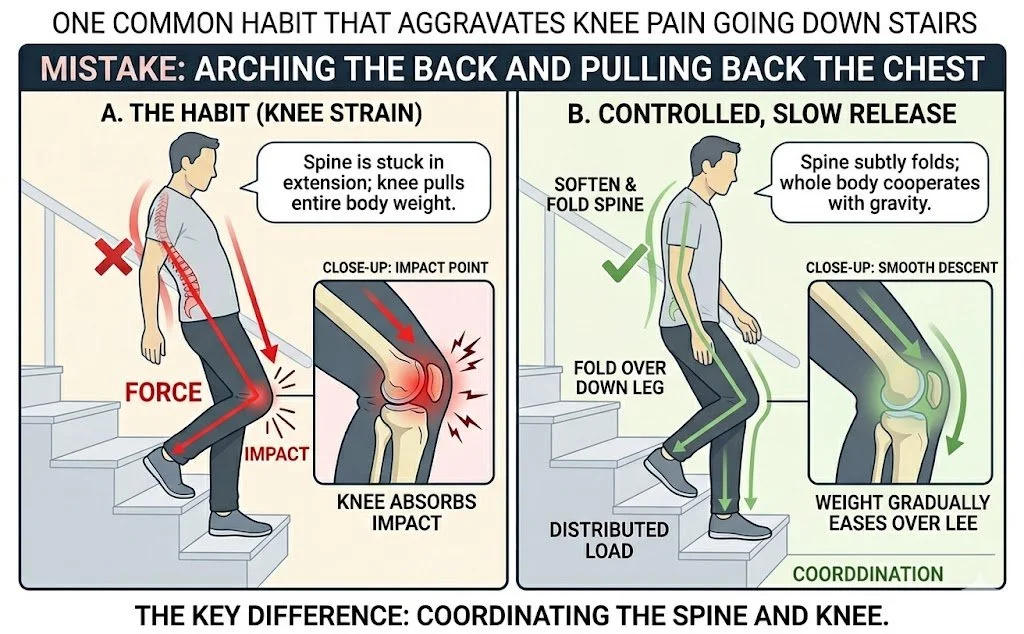
Over the years of helping clients with knee pain, one of the most common habits that contribute to knee pain coming down stairs is that their spine doesn’t know how to fold over the down leg.
Make it stand out
Whatever it is, the way you tell your story online can make all the difference.
Think of your body as a series of integrated gears. As one leg reaches down for the next step, your spine should subtly soften and "fold" to keep your center of gravity over your support. Instead, many of us do the opposite. The chest pulls backward and the back arches while the leg moves down the step. This creates a physical tug-of-war. Your knee is forced to "pull" the rest of your body weight forward and down, rather than your torso simply arriving over the leg.
This often stems from an over-corrected postural habit; trying so hard to "sit up straight" at your desk that the back becomes stuck in a state of permanent extension in all activities like climbing stairs, getting up from your office chair etc.
This is something that strengthening exercises alone often don’t fix, as I explain in 6 reasons physical therapy isn’t working and what to do instead.
The unlearning from long held habits like this requires a somatic learning environment where our spine can learn to take different shapes and not be stuck in one idea of being. With Feldenkrais based functional mobility sessions, it is possible to learn this in comfortable positions lying on the floor and moving gently with awareness. Once your brain and body have learned to co-ordinate the movement of upper and lower body on the floor, it takes that learning to an upright activity such as climbing on the stairs.
You can have the strongest legs in the world and still struggle on the stairs. If your knees hurt on the stairs, your body isn't "broken". It’s just looking for a more efficient way to handle gravity. The problem isn't so much about strength; it’s about timing, direction, and cooperation.When the whole body starts working together, the descent feels lighter, quieter, and far less threatening.
What’s the next ‘step’?
If you’ve been having knee pain off and on that gets in the way of doing what you love to do without suffering for it after; the first step is to shift your thinking about it. When you come from an informed place about what might be going on, you’ll be able to look for solutions that get you closer in actionable steps that work for your body, not just anybody. This is exactly why I created the Smart Relief Guide on ‘3 Hidden Mistakes that make your Knee Pain worse”and what to do instead.
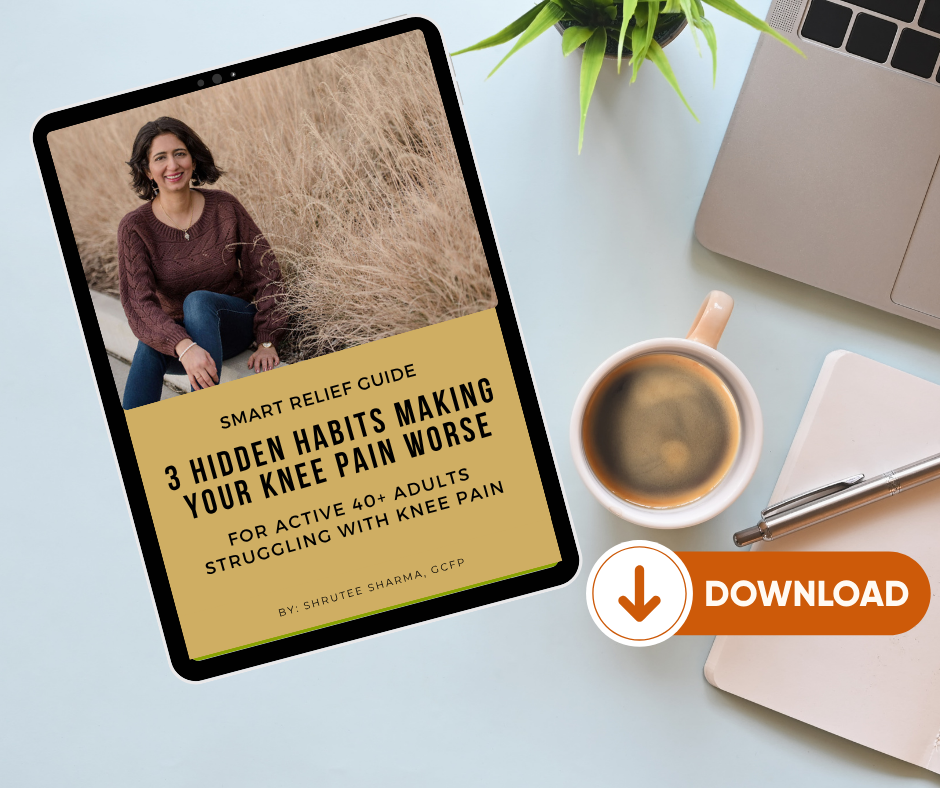
Inside, you’ll discover:
why your knee pain may not actually be a knee problem
how certain “good” habits can keep you stuck in the same pattern
simple ways to begin shifting how your body organizes movement without forcing or overcorrecting
2. If you’re in acute stages of pain but your mri was normal, suffered an injury or recovering from surgery for torn meniscus etc., reach out to me via this contact form and I’ll schedule time to discuss the best fit for you.