Why does my knee hurt when my tests are normal? A Case Study
When her knee suddenly started hurting, Anita couldn't point to an injury that explained it.
She hadn't fallen or twisted it playing a sport.
She wasn't exercising particularly hard.
She enjoyed walking and would often get in her 10,000 steps walking with a colleague or in evenings.
Sure if she played badminton or went for an unusually long hike, she felt sore afterward.
But she'd rest, and usually be fine the next day.
This was different. Her left knee was visibly swollen, painful and stiff.
And unlike the occasional soreness she'd experienced before, this wasn't disappearing after a day of rest.
Stairs became difficult. Going downstairs could sometimes produce a sudden “shock” sensation, almost as though she might lose her balance.
Anita wasn't trying to become an athlete.
She was trying to keep up with her life, living in California with a busy job, teenagers with full lives of their own, and aging parents thousands of miles away.
She’s at a stage of life when being able to walk comfortably mattered for reasons more than “getting her steps.”
She wanted to drive her daughter for college tours; walk on campus without wondering how far they'd have to go.
She wanted to get off a long flight and spend her visit with her parents, not spend it recovering from the journey.
The question underneath the pain was: Can I count on my knees for the life I need and want to live?
The tests ruled out the scary stuff but didn’t answer her big question
Anita did what you're supposed to do.
She went to her doctor who ordered bloodwork, an X-ray and an ultrasound to rule out anything concerning.
Bloodwork came out normal. The ultrasound found a benign Baker's cyst behind the knee.
Anita wasn't eager to do something invasive unless it was really necessary.
And she still had the question the tests hadn't answered for her:
Why did my knee suddenly start hurting when I didn't do anything to injure it?
She wanted to understand if there was something she was doing unconsciously that was hurting it and what she could change so the pain would go away.
That was the starting point of our work.
The first clue was hiding in her biggest pain point
Instead of starting with a list of exercises to strengthen her knee, we started with her biggest pain point - climbing stairs.
She had to go up and down the stairs a dozen times every day and the “shock” sensation was making her feel precarious and anxious.
Think about your own day. How many times do you navigate stairs without even thinking about it? At home, at work, in a parking garage?
When your knee hurts, something this ordinary can suddenly become something you plan around.
This is why zooming in on a frequent EVERYDAY ACTIVITY is one of the pillars of my work. I take something you do often like climbing stairs, getting out of a chair or walking or rolling out of bed and slow it down enough to see what your body is actually doing. Those ordinary movements often hold clues to the missing pieces in how your body is coordinating.
Think of it like sitting in a video editing room and slowing down the tape.
Once you can see what’s happening frame by frame, you can spot what needs to be edited out or what’s missing and needs to be added in.
Watching her climb stairs, it became very evident that Anita was throwing her upper body backward as she put her leg on the next step. This meant that her body didn’t fold forward to arrive on the leg she was stepping onto but fell behind, placing enormous strain on her legs to drag her torso along.
Because going up stairs involves your body not only moving forward but also up against gravity, knee strain is magnified with stairs.
Curiosity led pain relief is sticky
The discovery about her upper and lower body doing completely different things surprised Anita, and that made her curious.
Curiosity is the kind of food the nervous system loves to chew on.
Think about most exercises you’ve been given. Do they make you want to investigate? Do you find yourself wondering, Huh…what happens if I do it this way?
Probably not.
No wonder so many people either use willpower to get through their exercises or eventually stop doing them.
Nervous-system learning is different. Once something catches your attention, the improvement can take on a life of its own.
Hence EVOKING CURIOSITY strategically is another pillar of my work.
Once Anita discovered this disconnect between her upper and lower body, we started seeing it everywhere.
Not just on the stairs, but in walking, getting up from a chair, and many of the ordinary things she did every day.
We followed the trail. Using gentle movements on her back and side, we gave her nervous system opportunities to discover how her upper and lower body could work together.
We ended every meeting with coming back to standing.
Anita noticed how differently her body stacked over her feet.
The change wasn’t only physical. She also described feeling calmer and more grounded.
That’s one of the things I love about somatic movement.
We may begin with a physical problem, but we’re working with a whole person.
The way we move, sense, think and feel aren’t separate systems neatly divided from one another.
Why would we expect meaningful change to affect only one of them?
Walking, stairs, long flights “no problem”
Over the following sessions, Anita’s upper body learned what to do when she stepped forth with her leg.
The protection and vigilance in her left knee was being replaced with a flow.
She could bend her knee more comfortably.
Walking up the stairs became enjoyable. She even mentioned using this movement as her ‘practice’.
She could go on longer walks without the slight limp or irritation afterwards.
She could stand for an hour in the morning, cook and pack lunches with confidence.
Take 21 hour flights, her knee was “no problem throughout the trip.”
Ability to recognize what to do BEFORE pain gets bad
Something else was changing for Anita.
At first, pain was simply something that happened to her. She didn't know why it had appeared or what to do when it did.
She could notice things way ahead of pain setting off.
She could listen her own body cues to recognize when her upper and lower body were starting to disconnect.
She also began seeing how a stressful week at work, poor sleep or fatigue degraded her whole body co-ordination.
She course corrected sooner, knowing very clearly how her state of mind caused her body to fall back into old habits.
She had a better strategy than simply waiting for it to feel better.
She became resourceful with taking care of herself whether that meant reorganizing her calendar or
going to the online library, choosing the sensory movement practice that matched what she was noticing, follow along and get herself back on track
That's a significant shift: knowing exactly how to help yourself.
The next stage: solving for possibility, not pain
Now Anita is working on the next shift. Building the discipline for a somatic practice regularly, even when nothing hurts.
Because at this stage of life, it isn't just about keeping her knee comfortable today.
It's an investment with a much longer payoff.
It's time spent cultivating the awareness, adaptability and choices in movement that she wants to carry with her as she gets older.
So she can keep tending to the life that already matters deeply to her her work, her teenagers, those long journeys to see her aging parents.
And also have a body available for the life she hasn't lived yet.
When we started working together, Anita’s goals were understandably practical.
Climbing stairs, standing, walking without calculating how much her knee could bear, and comfortably taking an international flight.
But once those things stopped taking up so much of her attention, the conversation started to be about…
Exploring different parts of the Bay Area,
Taking swimming lessons,
And playing badminton properly again. Maybe even join a league like she had when she was younger.
That’s a very different relationship with your body.
From: How much can my knee tolerate?
To: What else might I be able to do?
On one San Francisco outing, she climbed 40 flights of stairs through the city's hills.
By the end, she was just tired and a little sore.
That’s a huge contrast from a knee you can’t even trust to maintain your balance on the stairs.
What Anita’s story teaches us about knee pain when the tests don't give you an answer
When a knee suddenly becomes painful and swollen, there are important things your doctor may need to investigate and rule out.
But sometimes you get reassuring results and are left with a surprisingly difficult situation:
Nothing serious has been found. But your knee still hurts.
That's where it can be useful to ask a different set of questions.
Not only: What does the image show?
But also: What happens when I actually use my knee?
Are there patterns simply hiding in how i walk, climb stairs etc, that I haven't noticed simply because I've been moving this way for years?
And most importantly: Can I find another way?
For Anita, that investigation began on the stairs.
And she went from limiting herself and being afraid of stirring up pain to being excited about what she could do.
That's the change I want for my clients.
Your tests look reassuring. So why are you still planning your life around your knee?
Is your X-ray or MRI normal, yet your knee still hurts?
Are you thinking twice about stairs, long walks, travel or all the other things your life asks your knees to do?
There may be another part of the picture worth investigating.
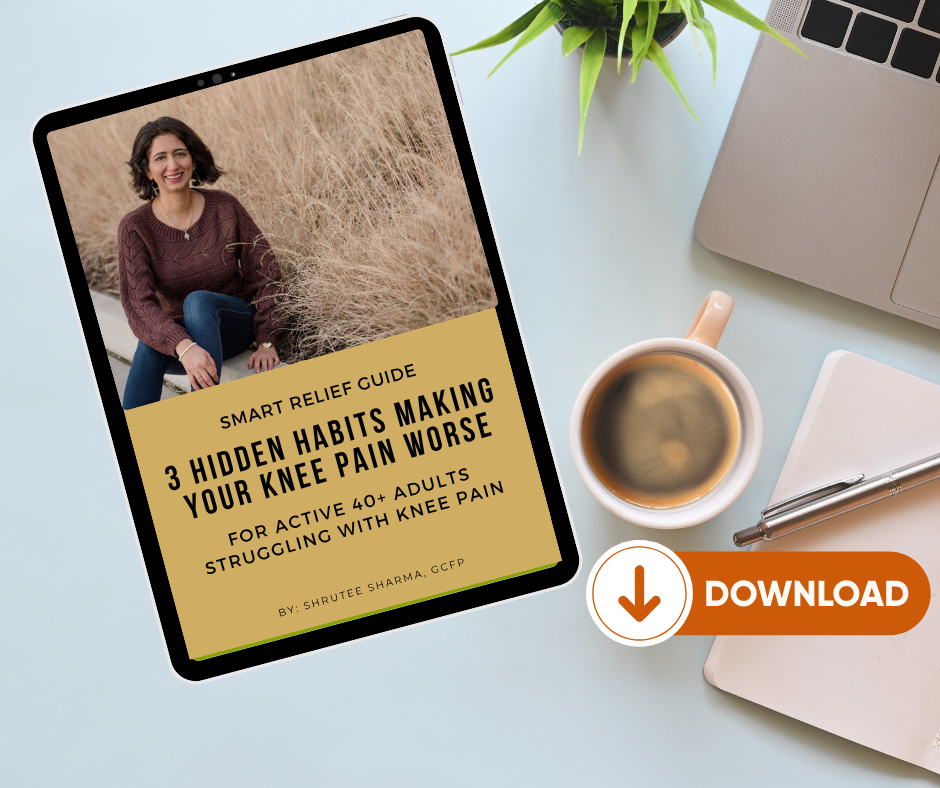
Download this free resource to discover 3 surprisingly common but hidden habits making your knee pain worse.
In this resource, I cover:
why your knee pain may not actually be a knee problem
how certain “good” habits can keep you stuck in the same pattern
simple ways to begin shifting how your body organizes movement without forcing or overcorrecting
Click here to download the guide.
Frequently Asked Questions
“Why does my knee hurt when nothing is wrong on my MRI?”
An MRI can tell us a lot about the structures inside your knee.
It can be the starting point for investigating how the strain or tear is caused. Read this article if you’re wondering if an MRI Miss the Cause of Your Knee Pain.
What if my MRI does show arthritis, a meniscus tear or other changes? Can movement still make a difference?
Learning to move better can help prevent further degeneration and occasionally even reverse the degeneration that happened by allowing the tissue to heal without continuing the everyday wear.
How is this different from physical therapy or exercises I've already done for my knee?
Physical therapy can include strength and mobility around the knee.
My work helps your nervous system learn through movement. It helps your whole body become better coordinated.
Read here to learn Why physical therapy may not have worked for you.