Shoulder blade pain won’t go away? It’s time to rethink posture advice
“I’m sitting up straight and pulling my shoulders back like I’m supposed to, so why do my shoulders still hurt?”
It is the great posture paradox. You’ve been told your whole life to stop slouching, so you’ve gotten used to "fixing" your posture. If this sounds familiar, your "good posture" might actually be locking your shoulder blades in a posture prison, preventing the very movement your joints need to stay pain-free.
What a healthy dance between the shoulder blade and arm feels like
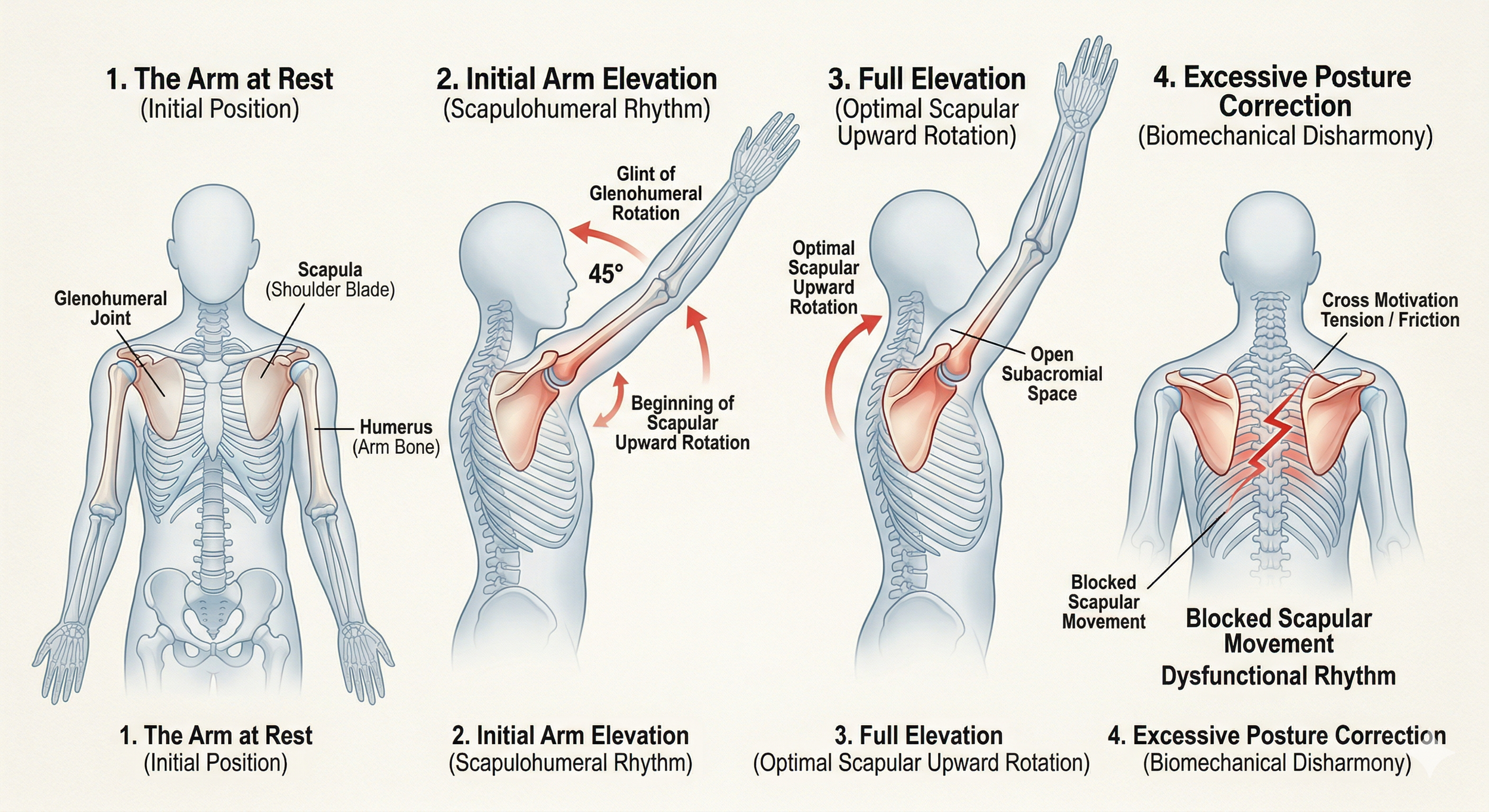
Think of your arm and shoulder blade as dance partners. In a healthy shoulder, they move in harmony; one leads, the other follows, and the movement feels fluid and supported. When you reach for something, the shoulder blade glides away from the spine to support that motion. A healthy shoulder blade is like a silent stagehand in a play; moving props, shifting scenery, making sure the star (your arm) can shine.
This gliding action is what gives your arm that extra length, even though your arm bones are a fixed length. When you push or pull, the shoulder blade acts like a biomechanical lever, providing a stable base for the muscles to generate power.
How posture correction backfires
When you habitually "pin" your shoulders back to "stand up straight," you are disrupting your scapulohumeral rhythm. This is the precisely coordinated timing between your arm bone (humerus) and your shoulder blade (scapula).
Landmark research on shoulder kinematics by Inman, Saunders, and Abbott shows that for every 2 degrees your arm moves, your shoulder blade needs to rotate roughly 1 degree to create space in the joint. If you have trained your muscles to keep your blades "tensed" toward your spine, you lose that essential scapular upward rotation.
Without this rotation, your arm bone essentially runs out of room. Instead of gliding, it begins to "pinch" against the acromion (the bony "roof" of your shoulder blade). This friction is why many people who try to fix their posture through force end up with shoulder impingement or chronic bursitis. You’ve effectively locked your shoulder blade in a "prison" of tension, preventing it from supporting your arm's movement.
This habitual 'hustle' doesn't just limit your gym performance; it often prevents your nervous system from down-regulating at the end of the day. If you find that your shoulder pain keeps you up at night, it’s often a sign that your brain has lost the ability to 'switch off' these protective bracing patterns even when you're horizontal.
The tug of war: From bursitis to shoulder impingement
This conflict intensifies when you reach overhead. In a healthy shoulder, the bottom tip of the shoulder blade spreads around the sides of your ribs. If the blade is stuck, the front of the arm rubs against a knobby part of the shoulder blade called the coracoid process.
This repeated friction can contribute to several common diagnoses:
Bursitis: Inflammation of the fluid-filled sacs that cushion the joint.
Rotator Cuff Tendinopathy: Wear and tear on the tendons due to poor coordination.
Frozen Shoulder (Adhesive Capsulitis): Where the joint becomes painfully restricted as the body tries to "protect" itself from the constant friction.
Bearing weight on your arms with a compromised shoulder such as in a Yoga Downward Dog or engaging in overhead sports like pickleball or tennis, can make you significantly more vulnerable to injury. When the "stagehand" (the shoulder blade) stops moving, the "star" (the arm) eventually burns out.
This challenge is especially unique for those managing structural asymmetries; for example, shoulder relief with scoliosisrequires looking at how the shoulder blade adapts to the spine's curve rather than just trying to force it into a 'straight' position."
Restoring healthy partnership: The Feldenkrais Advantage
So how do we restore this healthy dance between your arm and shoulder blade?
By helping your shoulder unhinge from its stuck position and glide freely in all three planes of movement.
The Feldenkrais Method® accomplishes this by moving beyond the muscles and targeting the "control center" your nervous system. Unlike traditional modalities that may use force or manual manipulation, we use neuromuscular re-education.
Instead of fighting the habit, we gently exaggerate it. We shine a spotlight on the tension. We explore how the movement of the shoulder blade can become congruent with the ribs, sternum, hips, and back. The habit isn't "bad"; it’s just stuck in a rut. When we integrate the shoulder into the context of whole-body movement, the brain finally receives the signal that it is safe to let go.
Take the next step: The Shoulder Masterclass
If you’ve tried the typical exercise approach stretching, strengthening, or "fixing" your posture only to find the pain keeps coming back, it’s likely because the underlying neural habit hasn't changed. The Shoulder Masterclass is designed to bridge this gap. This program connects shoulder health directly to your nervous system’s capacity for lasting change.
Join me to explore the 5 Keys to a Healthy Shoulder. Together, we will restore the "glidiness" of your shoulder blades through movements that soothe your senses and your body.
Why "brain learning" creates lasting relief
This approach is grounded in the science of neuroplasticity: your brain’s ability to rewire movement patterns based on new experiences. Research from the University of Washingtonhighlights that evidence-based interventions can drive brain plasticity in a positive direction at any age. They describe 'newness' and 'challenge' as essential drivers for building brain power and driving health in a positive direction.
When you gently interrupt old habits with the novel movements found in The Shoulder Masterclass, you aren't just stretching muscles, you are literally rewiring your brain for ease. You help your brain prioritize patterns that are efficient and pain-free.
This kind of learning is "sticky." It doesn't require a lifetime of daily "reps" because it changes the subconscious blueprint of how you move. A stuck shoulder often reflects a "stuck" neural map. As you develop a flexible shoulder that can adapt to support your arm in real-time, you are also developing a more flexible, resilient mind.
Ready to break free from the posture prison? Sign up for the Shoulder Masterclass here or reach out to me with this contact form to discuss your specific path to relief.